One of my favorite activities this year—though, really, I love all my activities dearly—was singing in the Community Music School’s Vocal Chamber Choir. I enjoyed every minute with this group.
The first part of the year our theme was dreams. Our songs included Gabriele Fauré’s Après un Rêve (sung in the original French), the ever so tragic I Dreamed a Dream, the almost equally hopeful A Million Dreams, and Nella Fantasia (sung in the original Italian).
In April, we performed at the All Voices concert alongside other choirs at the beautiful Montante Hall.
From our dramatic cries of “Helas! Helas, triste reveil songes…” to a variety of traditional African American spirituals that kept me on my feet, hands clapping, nearly ready to start dancing in the aisles—were I less reserved individual, I might have done just that—it truly was a night of “all voices.” I must have smiled for at least an hour after it was over.
I found it hard to believe I would like the new pieces as much, especially with less than two months to work together. Nevertheless, our director, Maria Goodrich, did not disappoint. She chose three Robert Frost poems adapted for song. Though all three were delightful, I enjoyed Choose Something Like a Star best.
I found myself meditating on Frost’s Star long after I finished practicing.
“Say something [we demand, for the second time, in forte]. And it says, ‘I burn’ [it responds in a high C]. [That response is inadequate; we demand more]. But say to what degree of heat. Talk Fahrenheit, talk Centigrade. Use language we can comprehend. Tell us what elements you blend. It gives us very little aid, but still says something in the end.”
I feel Frost has perfectly encapsulated the human experience, or more accurately, our shortcomings.
Surrounded by the majesty of creation, we demand to control, to dominate, to name. In Genesis, Adam names God’s creation.1 We demand an explanation, not only from the stars, but from God as well. Failing to find a satisfactory explanation, we cast Him aside. “He has not answered. Therefore, surely, He must not exist,” we conclude.
Frost’s words also call to mind an article in which some lament the absence of the flying cars that 20th century scientists thought were inevitable, or the race to colonize the universe.
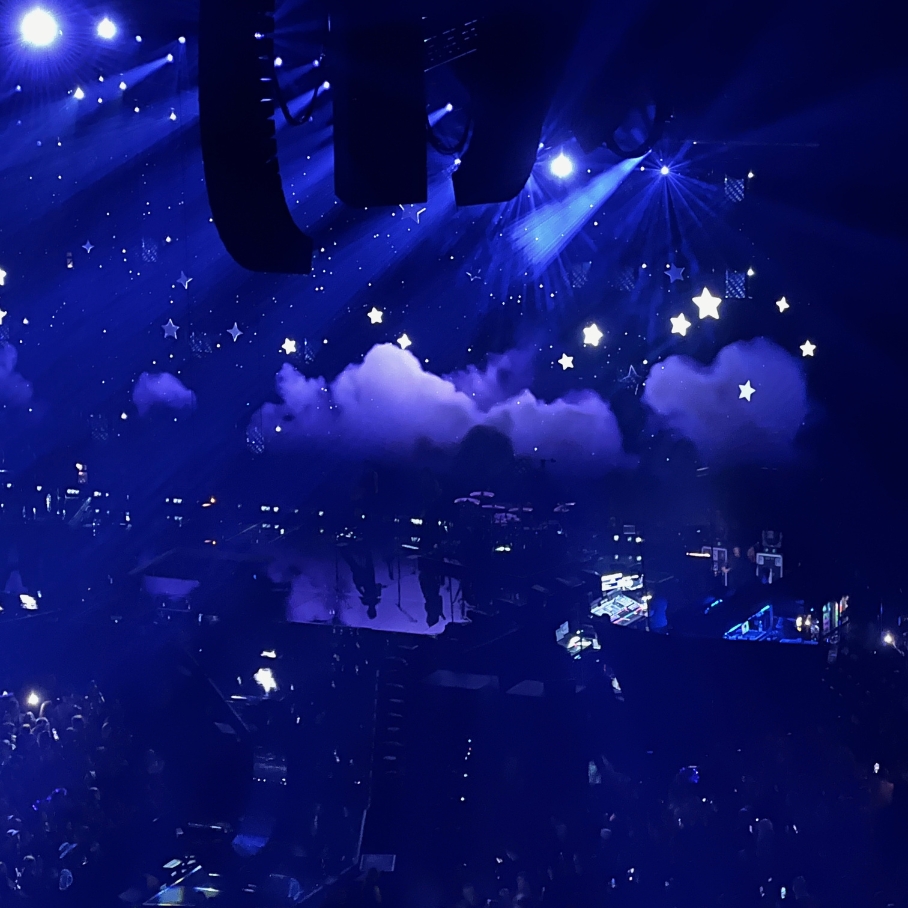
The end of the song invites us to go against our nature and “stay our minds” on “something like a star.”
Put another way, “Be still and know that I am God.” (Psalm 46:10).
The majesty of creation asks this of us. Do we dare hold fast to our indifference?
- In She Unnames Them, the woman formerly know as Eve is the impetus for all of creation renouncing the names Adam has given. (See, Ursula K. Le Guin, She Unnames Them, The New Yorker, Jan. 21, 1985, at 27. (“They seemed far closer than when their names had stood between myself and them like a clear barrier…”). ↩︎